



Alcoholic Beverage X-ray Inspection System: Penetrative Imaging for Premium Baijiu Quality and Authenticity
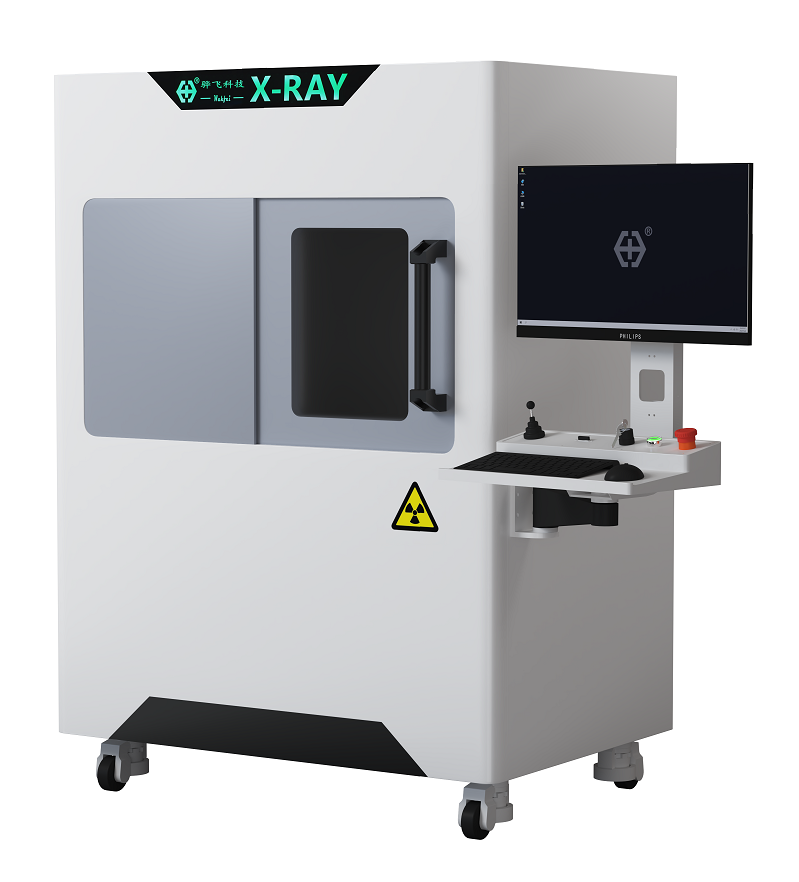
In the premium baijiu market, the value of a bottle of Moutai lies not only in the liquor itself, but also in its irreplaceable "identity." However, counterfeiting and quality defects—such as micro-drilling, refilling, and cap tampering—are eroding brand reputation in increasingly subtle ways. The Alcoholic Beverage X-ray Inspection System uses non-destructive penetrative imaging to reveal the internal structure of every bottle on screen, making it a critical component of quality control and anti-counterfeiting traceability systems for distilleries.
Why Does Premium Baijiu Need X-ray Inspection?
Traditional baijiu inspection has significant blind spots:
Counterfeiting techniques keep evolving. Criminals extract genuine liquor through micro-holes (often smaller than 0.5mm) and refill with fake products, or replace the entire bottle contents, leaving the exterior almost indistinguishable from the original.
Leak detection has blind spots. Conventional methods cannot detect refilling through hidden holes or tampered caps when the liquid level appears unchanged.
Manual sampling coverage is extremely low. Sampling rates are generally below 0.1%, relying on subjective experience and prone to missed or false judgments.
X-ray inspection directly "sees through" the bottle body: without opening the bottle or damaging the liquor, it can inspect the stopper edge, cap seal, and internal structure.
How the Alcoholic Beverage X-ray Inspection System Works
The system uses a micro-focus X-ray tube as the light source. The X-rays penetrate the bottle and form an image on a digital flat-panel detector, after which an AI vision algorithm recognizes and judges the image. The core workflow is as follows:
X-ray emission: A 90kV micro-focus sealed tube emits low-dose X-rays with a target power of only 8W.
Penetrative imaging: The rays pass through the glass/ceramic bottle wall and the liquor, forming a grayscale image on the high-resolution digital flat-panel detector (FPD).
360° rotation: The rotary stage turns the bottle to capture multi-angle images without scanning blind spots.
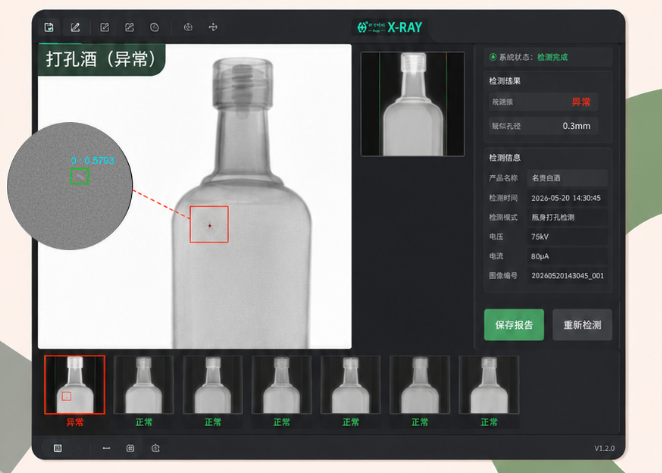
AI intelligent judgment: Deep learning models identify defects such as body drilling and cap pulling, and automatically mark them with coordinate-level precision.
Key Features
1. 360° Rotary Stage for All-round Scanning
A high-precision rotary workbench compatible with Φ82mm, Φ100mm, and Φ150mm stages, capturing multi-angle images of a single bottle with no blind spots on the body, shoulder, or base.
2. Large Capacity Inspection
Supports 500mL to 5000mL large bottles, as well as irregular, ceramic, and glass bottles. The oversized stage design meets the inspection needs of various packaging specifications.
3. High-definition Bottle-neck Inspection
A 5.8 LP/mm high-resolution FPD detector makes the structural details of the cap, stopper, and sealing ring clearly visible, enabling precise recognition of micron-level defects.
4. Automatic Fine-hole Positioning
AI image algorithms automatically identify micro-holes above Φ0.3mm on the bottle body or shoulder, output coordinate-level positioning, and visually annotate defects on the image for easy re-inspection and traceability.
Technical Specifications
| Category | Item | Specification |
|---|---|---|
| X-ray Tube | Type | Micro-focus sealed tube (Closed tube) |
| Max Voltage | 90KV | |
| Max Current / Target Power | 200μA / 8W | |
| Detector | Type | High-resolution digital flat-panel detector (FPD) |
| Resolution | 5.8 LP/mm | |
| Stage | Size | Φ82mm / Φ100mm / Φ150mm |
| Max Height | 300mm | |
| System | External Dimensions | 1100mm(L) × 750mm(W) × 1500mm(H) |
| Weight | Approx. 550KG | |
| Power Supply | 220VAC, 50/60Hz | |
| Operating Environment | 0℃ ~ 40℃ / 30 ~ 70RH | |
| Equipment Power | Equipment Power | 1.3KW |
| Radiation Safety | X-ray Leakage | < 1 μSv/h |
Application Scenarios
Alcoholic Beverage Distributors: Authentication of premium liquor buybacks; after-sales dispute resolution with credible evidence; value-added service extension that increases revenue and foot traffic, while enhancing transaction credibility and pricing leverage through objective evidence.
Quality Supervision Agencies: On-site rapid inspection, circulation sampling, and case evidence collection by market regulation bureaus, customs, and commodity inspection departments.
Frequently Asked Questions (FAQ)
Q: What are the advantages of the X-ray solution compared with manual sampling?
A: The X-ray solution directly observes the internal bottle structure, with a false detection rate of<0.05%.
Q: Is hardware replacement required for different bottle types?
A: The inspection chamber is compatible with three standard stages: Φ82mm, Φ100mm, and Φ150mm.
Q: Does X-ray inspection affect the liquor inside? Will it change the taste?
A: No. The system uses a 90kV micro-focus sealed tube with a target power of only 8W. Single-scan exposure is short (usually<5 seconds), and the low ray energy causes no perceptible change in liquor temperature, composition, or taste.
Q: Is an X-ray leakage level of<1μSv/h safe?
A: 1μSv/h is about 1/200 of the natural background radiation level, far below the dose limits for workers and the public specified in national standard GB 18871. The equipment uses a fully shielded lead-lined cabinet, and the operator position and entry/exit ports have been validated by dosimetry.
Q: What is the smallest hole size that can be detected?
A: Equipped with a 5.8 LP/mm high-resolution digital flat-panel detector, the system can identify micro-holes above Φ0.01mm under standard detection distance, with automatic positioning and marking of tiny holes on the bottle body and shoulder. Actual detection capability is affected by bottle wall thickness, material, and scanning parameters; sample testing is recommended for verification.