



X-ray inspection for wire damage and connector breakage
- Pubdate 2026-02-25
X-Ray Inspection Solutions for Wire Damage and Connector Open-Circuit Issues
Precisely identify internal fractures, stress damage, and hidden open-circuit defects to provide reliable assurance for wire harness and connector manufacturing
Wire Stress Damage: Invisible Potential Failure Sources
During wire processing, crimping, bending, transportation, and assembly, the conductor often withstands complex mechanical stress. Even if the outer insulation layer remains intact, the internal copper strands may have already experienced breakage, filament elongation deformation, or localized poor contact. Such defects may still conduct in the early stage, but under long-term vibration or temperature rise conditions, they are highly likely to evolve into intermittent open circuits, becoming the root cause of after-sales risks.
Traditional pull testing or continuity testing can only verify results, but cannot reveal the internal structural condition. Through industrial-grade X-Ray inspection equipment, the conductor arrangement, strand break positions, and stress deformation can be directly observed without destroying the sample, allowing risky batches to be identified in advance.
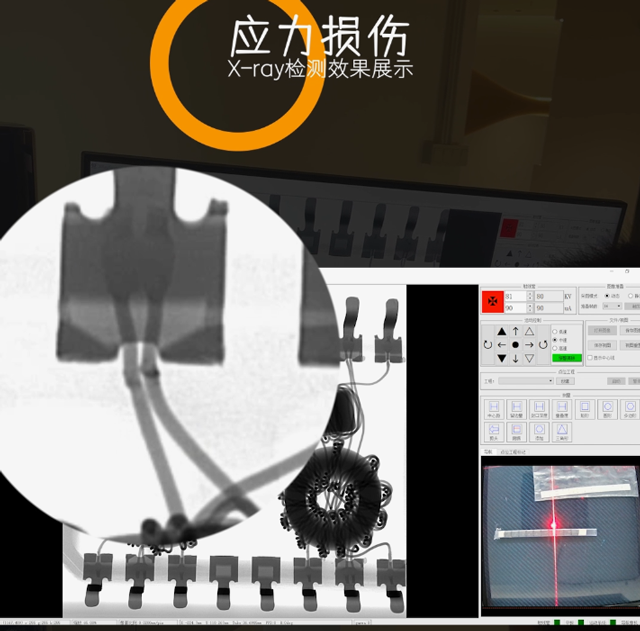
X-Ray imaging results of internal wire stress damage
Connector Broken Wires and Open Circuits: Quality Risks Hidden Inside the Housing
Poor terminal crimping, cold solder joints, or pin breakage inside connectors are often completely concealed by the plastic housing. Visual inspection and electrical sampling tests cannot accurately locate the specific structural position of the breakage. Once “intermittent failures” occur at the customer’s site, root cause tracing becomes extremely costly.
Through X-ray fluoroscopy, the terminal crimping shape, solder filling condition, and the presence of broken strands or internal open circuits can be clearly presented. The quality department can not only determine pass or fail status, but also optimize crimping parameters and mold conditions based on the findings, achieving true data-driven closed-loop management.
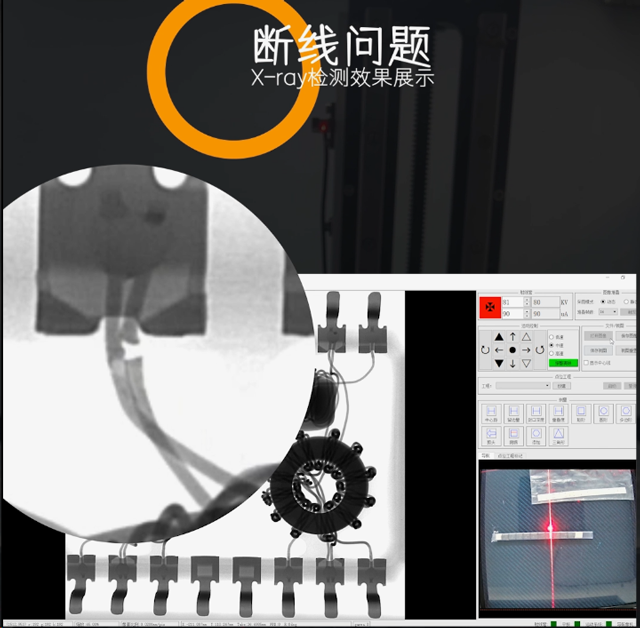
X-Ray inspection of internal broken wires and open-circuit defects in connectors
Practical Value for Wire Harness and Connector Manufacturers
Wire and connector products are widely used in automobiles, energy storage systems, power supply systems, and industrial control equipment. Once failure occurs, it often involves system shutdown or even safety risks. Rather than bearing recall costs and reputational losses on the client side, it is better to establish structural-level verification capability before shipment.
The significance of industrial X-Ray inspection is not merely “seeing inside,” but more importantly establishing a traceable and quantifiable quality evaluation basis. When key samples of each batch can be structurally imaged and recorded, companies no longer rely on experiential explanations when facing customer audits or technical inquiries, but instead provide image data as evidence. This capability holds practical significance for undertaking high-end customer orders and entering stringent certification systems.
For enterprises evaluating upgrades to their internal inspection capabilities, introducing a professional X-Ray system is a long-term investment in product reliability and brand reputation, rather than merely a purchasing decision for a piece of inspection equipment.