How Does an X Ray Work? From the Source to an Internal Image
How does an x ray work in an industrial inspection system? A source produces X-rays, the sample changes how much radiation reaches the detector, and the imaging system converts the detected signal into a view of internal structure. The image reflects differences along each beam path through the object.
The sample changes the transmitted signal
In a conventional X-ray tube, electrons accelerate from a cathode toward a target. Their interaction with the target produces X-rays and heat. As the X-rays pass through a sample, absorption and scattering reduce the transmitted beam. The amount of attenuation depends on the material, the thickness along the beam path, and photon energy.
A void can change the transmitted signal because it replaces some of the surrounding material along that path. Whether it is visible depends on its size and orientation, surrounding structures, contrast, noise, and spatial resolution. Grayscale polarity can be inverted in software, so a bright region should not be labeled as a void without understanding the display convention and sample structure.
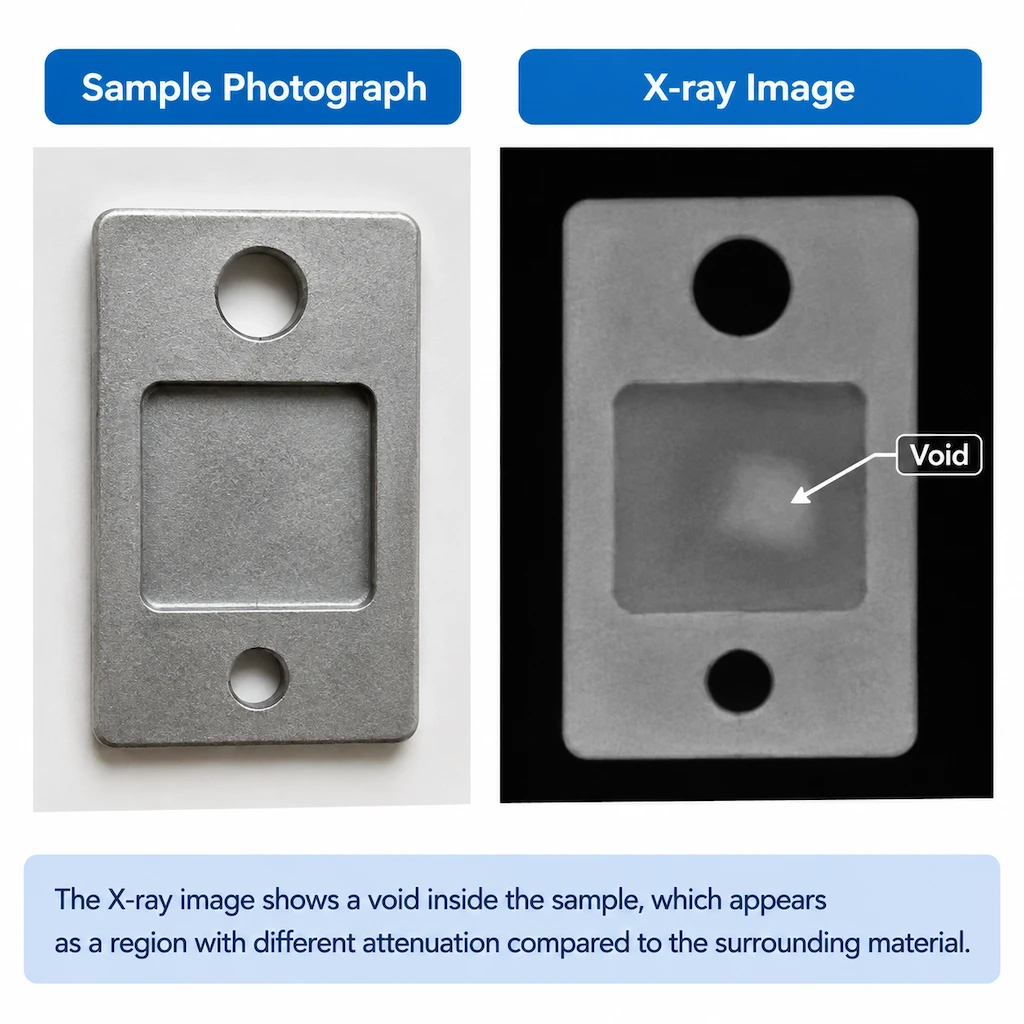
sample photograph and corresponding X-ray image
One image combines information through the thickness
A projection image places structures at different depths onto the same two-dimensional view. Changing the viewing angle can help separate overlapping features; suitable computed tomography equipment can reconstruct sectional information from multiple projections. Shenzhen Wahfei Technology Co.,Ltd. manufactures industrial X-ray inspection equipment. For a practical inspection discussion, begin with the internal feature that needs to be seen and evaluate whether the selected imaging method provides enough evidence to assess it.