
X-Ray Insights

Back
Detailed Explanation of Microfocus X-Ray CT 3D Reconstruction Technology
Pubdate 2026-01-20


Micro-focus X-Ray CT tomography 3D reconstruction technology, as a core technology of CT equipment, primarily performs Industrial Computed Tomography (ICT) on products in the industrial field. It is an imaging inspection technology that reconstructs images of an object's internal structure based on external projection data. This technology mainly includes Planar CT Flying Shot Imaging Technology, High-Precision Calibration Technology, Fast Analytical 3D Reconstruction Technology, High-Precision Iterative 3D Reconstruction Technology, High-Precision Volume Data Enhancement Technology, and 3D/CT Image Processing Technology. Based on this technology, Wahfei has developed 3D/CT automatic online inspection equipment capable of high-resolution real-time image acquisition and reconstruction.

Planar CT Flying Shot Imaging Technology                

Planar CT Flying Shot Imaging Technology consists of two core components: high-speed flying shot and real-time reconstruction. Using this technology, inspection speed is increased by more than 4.5 times compared to the previous generation models. High-speed flying shot primarily utilizes high-speed motion control and flying shot imaging. While ensuring high-speed equipment movement, it can algorithmically correct inherent mechanical deviations and assembly deviations using high-precision calibration technology according to reconstruction requirements. Planar CT real-time reconstruction technology performs the reconstruction of X-Ray projection images concurrently with the flying shot process, eliminating the need to wait for all projection images to be acquired before reconstruction. In other words, upon completion of the flying shot, 3D/CT reconstruction can be completed simultaneously.

Parallel-Plane Flying Shot Imaging Technology mainly offers the following advantages:
First,                    Comprehensive coverage of various flat objects, such as precision components in the electronic information industry like PCB boards, chips, IGBTs, liquid crystal panels, etc.;
Second,                    High resolution of the reconstructed volume data, with the highest resolution reaching 6μm;
Third,                    Acquisition of high-quality images under low contrast. The X-Ray source and detector of Parallel-Plane CT projection technology can be positioned close to the object for imaging, facilitating the acquisition of high-quality images with low radiation dose.
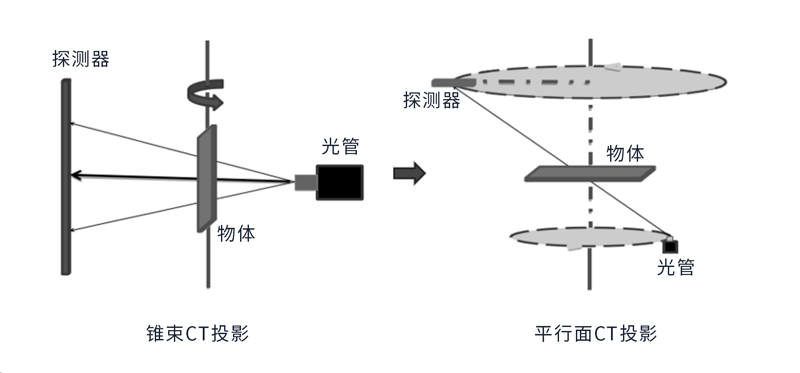
Schematic diagram of Cone-Beam CT projection and Parallel-Plane CT projection

Schematic diagram of Cone-Beam CT projection and Parallel-Plane CT projection

Parallel-Plane Flying Shot Imaging Technology mainly consists of two parts: Parallel-Plane CT Projection Technology and Flying Shot Imaging Reconstruction Technology. It balances application scenarios, inspection accuracy, and inspection efficiency, effectively addressing the main issues in current X-Ray inspection across various fields.

A. Parallel-Plane CT Projection Technology

Parallel-Plane CT Projection Technology, in contrast to Cone-Beam CT Projection Technology, refers to the dual-ring motion of the X-Ray source and detector around the central axis, with the object being reconstructed on this central axis.

B. Flying Shot Reconstruction Technology

Flying Shot Reconstruction Technology, also known as Real-Time Reconstruction Technology, refers to the technology that completes rapid imaging and real-time reconstruction while the inspected object is in high-speed motion. As shown in the timing analysis below, Flying Shot Reconstruction Technology can significantly reduce reconstruction time compared to traditional reconstruction techniques, enabling parallel processing of imaging and reconstruction.
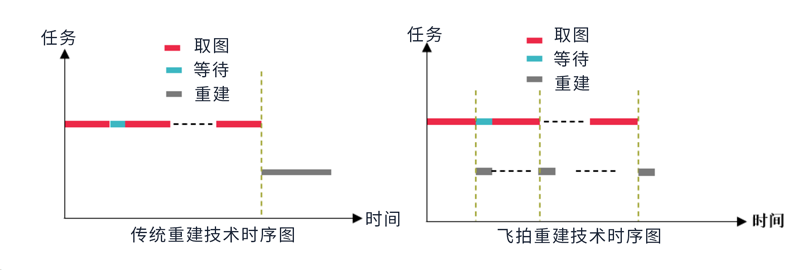
Timing diagram of Conventional and Flying Shot Reconstruction Technologies
Timing diagram of Conventional and Flying Shot Reconstruction Technologies

② Fast Analytical 3D Reconstruction Technology                

Fast Analytical 3D Reconstruction Technology refers to the technology that uses fast analytical algorithms for 3D reconstruction. Traditional analytical reconstruction algorithms are based on the Radon transform and Fourier slice theorem. Through multiple mathematical transformations developed by Wahfei, Direct Fourier Reconstruction Algorithm and Filtered Back Projection Reconstruction Algorithm have been advanced, significantly improving the speed of 3D reconstruction.

Traditional analytical reconstruction algorithm technology cannot perform parallel reconstruction on high-performance hardware. Wahfei's independently developed Fast Analytical 3D Reconstruction Technology, through parallel computing design, enables rapid 3D reconstruction on high-performance processors. It improves reconstruction speed while ensuring high-quality cross-sectional images, clearly displaying the locations of various defects. Currently, this technology can achieve projection reconstruction within 50ms and generate volume data of size "1000×1000×100" (X, Y, Z), with reconstruction time being about 1/10 of that of traditional analytical methods.

③ High-Precision Iterative 3D Reconstruction Technology                

High-Precision Iterative 3D Reconstruction Technology improves the accuracy of iteratively reconstructed images based on general iterative methods. It mainly includes multiple iterative cycles of projection and back-projection processes, which can better handle image artifacts caused by electronic noise and other physical factors, thereby reducing the required X-Ray dose during inspection while ensuring image quality. The basic principle of this technology is to abstract the cross-sectional information of the inspected object into a data matrix and establish equation systems for solving based on projection data from different directions.

High-precision iterative algorithms are broadly divided into two categories: Algebraic Iterative Reconstruction Algorithm and Statistical Iterative Reconstruction Algorithm. Their reconstruction quality is superior to analytical methods, but the speed is slower. The independently developed High-Precision Iterative 3D Reconstruction Technology, combined with GPU acceleration, achieves fast 3D reconstruction.

④ High-Precision Volume Data Enhancement Technology                

High-Precision Volume Data Enhancement Technology refers to selectively enhancing the volume data after it is generated by 3D reconstruction. Enhancement algorithms mainly include Volume Data Sharpening Algorithm, Volume Data Filtering Algorithm, and Super-Resolution Algorithm. By fitting and matching these algorithms through certain means, enhancement effects are achieved. The main purpose is to reduce artifacts, improve the signal-to-noise ratio, and enhance the quality of cross-sectional images.

A. Volume Data Sharpening Algorithm

The independently developed Volume Data Sharpening Algorithm not only sharpens cross-sectional images but also effectively enhances the contour information and reduces artifacts in cross-sectional images by performing sharpening processing on the volume data.

B. Volume Data Filtering Algorithm

The independently developed Volume Data Filtering Algorithm improves the contrast of cross-sectional images and reduces blurry information in the volume data by performing filtering processing on the volume data.

C. Super-Resolution Algorithm

The company has independently developed a Super-Resolution Algorithm that can reconstruct high-resolution volume data from low-resolution projection images, making defects more apparent upon image magnification, which is beneficial for defect detection. At the same resolution, using the Super-Resolution Algorithm can resolve images with a larger field of view. For example, images with a 16μm resolution can achieve an effective 8μm resolution effect using the Super-Resolution Algorithm.

Wahfei X-Mind AI Super-Resolution Algorithm Effect Diagram

Wahfei X-Mind AI Super-Resolution Algorithm Effect Diagram

⑤ 3D Image Slicing and Rendering Technology                

3D Image Processing Technology refers to displaying the imported volume dataset in the form of 3D effects and断层切片 (cross-sectional slices), allowing CT data to be displayed interactively from any angle. CT reconstructed images are a set of volume data. The editing and processing of volume data mainly include 3D Image Slicing and Rendering Technology. Original images may appear relatively monotonous and not easily highlight 3D effects. After 3D rendering, the volume data can be planar-cut in the desired direction, enabling users to obtain detailed information on various cutting planes.

A. 3D Image Slicing Technology

3D Image Slicing Technology refers to slicing and displaying volume data from three dimensions, mainly including XY transverse plane slicing, XZ sagittal plane slicing, and YZ coronal plane slicing. Slicing information from different dimensions can better restore the internal features of the product.

B. 3D Image Rendering Technology

3D Image Rendering mainly includes contrast stretching of voxels, 3D color filling, and brightness adjustment, etc. 3D Image Slicing Technology and 3D Image Rendering Technology complement each other. They analyze various defects in the slices required by customers and render the slice information, making defect information easier to identify and quantify.

Feedback and Inquiry

Would you like to confirm whether our X-Ray inspection systems can meet your product?
Read more