



Is X-ray inspection equipment radiation safe? What are the safety standards? National standards | on-site measurements
- Pubdate 2026-03-14
The Question Most Companies Ask Before Purchasing an X-Ray System: Is Industrial X-Ray Inspection Equipment Safe from Radiation?
In the field of industrial inspection, X-Ray inspection equipment has become an essential quality control tool in industries such as electronics manufacturing, precision machining, new energy, and semiconductors. However, there is one very important question that deserves attention:
“Will X-Ray inspection equipment pose radiation risks to operators?”
This concern is completely understandable. After all, the term “X-ray” often reminds people of medical radiology or nuclear radiation. In reality, compliant industrial X-Ray inspection equipment must meet strict national safety standards during design and manufacturing, and incorporates rigorous radiation protection measures.
Here we combine national standards with radiation measurement data from Wahfei X-Ray equipment to help you clearly understand the actual radiation levels and safety protection of industrial X-Ray systems.
1. National Standard Requirements: What Is the Radiation Dose Limit for Industrial X-Ray Exposure?
According to the technical guidance document GB/Z 41476.1-2022, the recommended limits for X-ray radiation exposure are as follows:
Occupational Exposure Dose Limits:
Annual effective dose: 20 mSv
Annual equivalent dose for the lens of the eye: 150 mSv
Annual equivalent dose for extremities or skin: 500 mSv
In simple terms, these values represent the safety limits established by national regulations for personnel who may be exposed to radiation over long periods. As long as equipment radiation levels remain far below these limits, the exposure is considered safe and controllable.
2. What Is the Measured Radiation Level of Wahfei X-Ray Inspection Equipment?
To help customers clearly understand equipment safety, we perform real-time radiation testing using professional radiation detectors before shipment and record the entire measurement process.
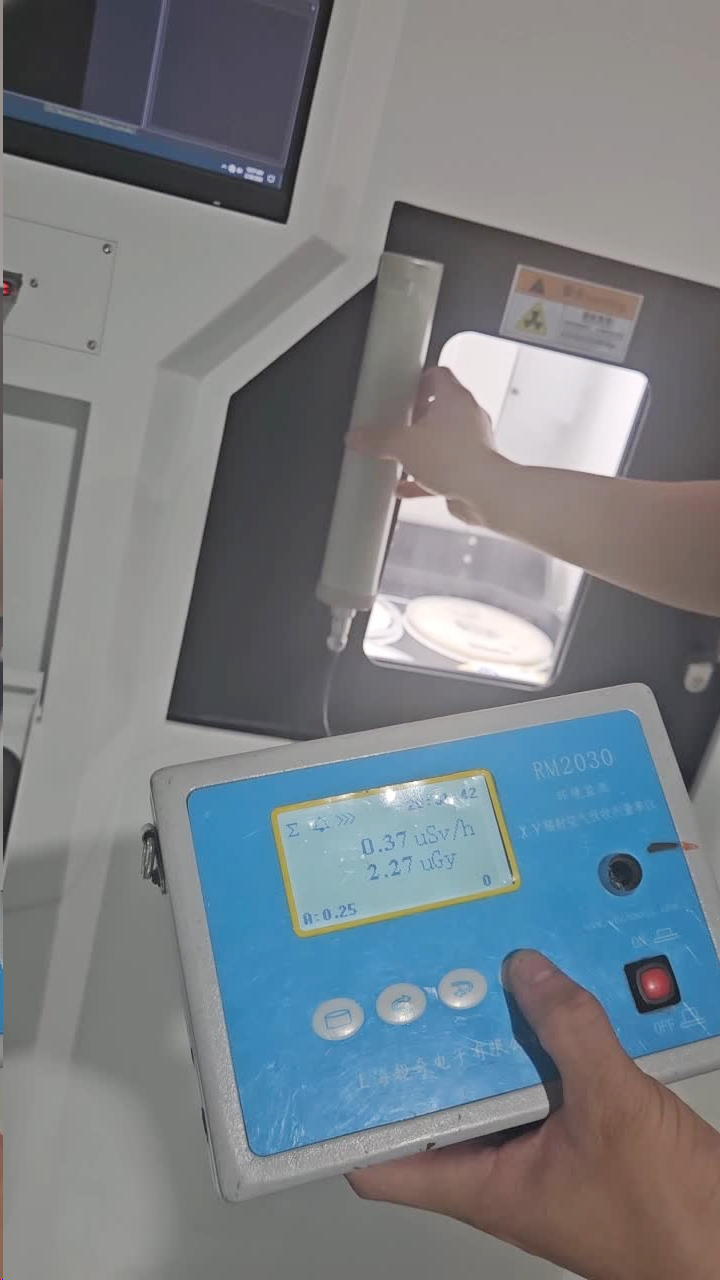
During actual testing, the maximum radiation level detected from our equipment is:
≤ 0.37 μSv/h
3. What Does 0.37 μSv/h Actually Mean?
Many people feel confused when they first see this unit: what exactly does μSv/h represent?
A simple explanation:
μSv = microsievert (radiation dose unit)
1 mSv = 1000 μSv
If calculated using the maximum measured value:
0.37 μSv/h × 8 working hours = 2.96 μSv / day
That equals:
0.00296 mSv / day
Even assuming 250 working days per year, the total annual dose would only be:
Approximately 0.74 mSv / year
Meanwhile, the national occupational exposure limit is:
20 mSv / year
In other words:
The radiation level of Wahfei X-Ray inspection equipment is only about 1/27 of the national occupational exposure safety limit.
This value is far below the regulatory safety threshold and also lower than many levels of natural background radiation encountered in daily life.
4. Why Can Industrial X-Ray Equipment Achieve Such Low Radiation Levels?
Modern industrial X-Ray inspection systems reduce radiation leakage through multiple engineering design measures:
• Fully enclosed lead shielding structure
• Safety interlock protection system
• Automatic X-ray shutdown protection mechanism
• Multiple radiation leakage monitoring measures
Under standardized operation, radiation generated during equipment operation will not pose health risks to operators.
Wahfei X-Ray systems have been widely used in electronics manufacturing, precision machining, and SMT production, helping companies achieve non-destructive inspection and reliable quality control. You can explore real customer applications here: View customer application case
Or learn about the actual operating process of the equipment: View X-Ray inspection equipment operation process