Kinds of X Ray: Projection Images, Live Views, and CT Volumes
For manufacturers comparing kinds of x ray, a useful starting point is the form of the inspection result. A projection image shows the combined effect of material along the beam path. A live view lets an operator observe changing projections as the sample moves. Computed tomography (CT) reconstructs a volume from multiple projections. These are imaging approaches, rather than different fundamental kinds of radiation.
A projection shows structure along a viewing direction
Digital radiography records a two-dimensional image using a digital detector. It can help reveal hidden assembly features or differences in material thickness, but structures at different depths may overlap. Live digital viewing uses successive images to support positioning and examination from different directions. Moving a part can clarify a feature, although a live display does not by itself produce a three-dimensional reconstruction.
A CT volume adds depth information
CT combines projections acquired from multiple viewing angles into volume data. Virtual slices can help separate features that overlap in a conventional radiograph. The additional depth information is useful when the inspection question concerns an internal location or spatial relationship. Its usefulness still depends on sample geometry, penetration, image quality, and reconstruction conditions.
For a discussion with Shenzhen Wahfei Technology Co.,Ltd., start with the evidence required: an internal overview, observation while repositioning, or depth-resolved information. Ask which proposed configuration can provide that evidence on representative parts. Not every X-ray machine supports every imaging approach.
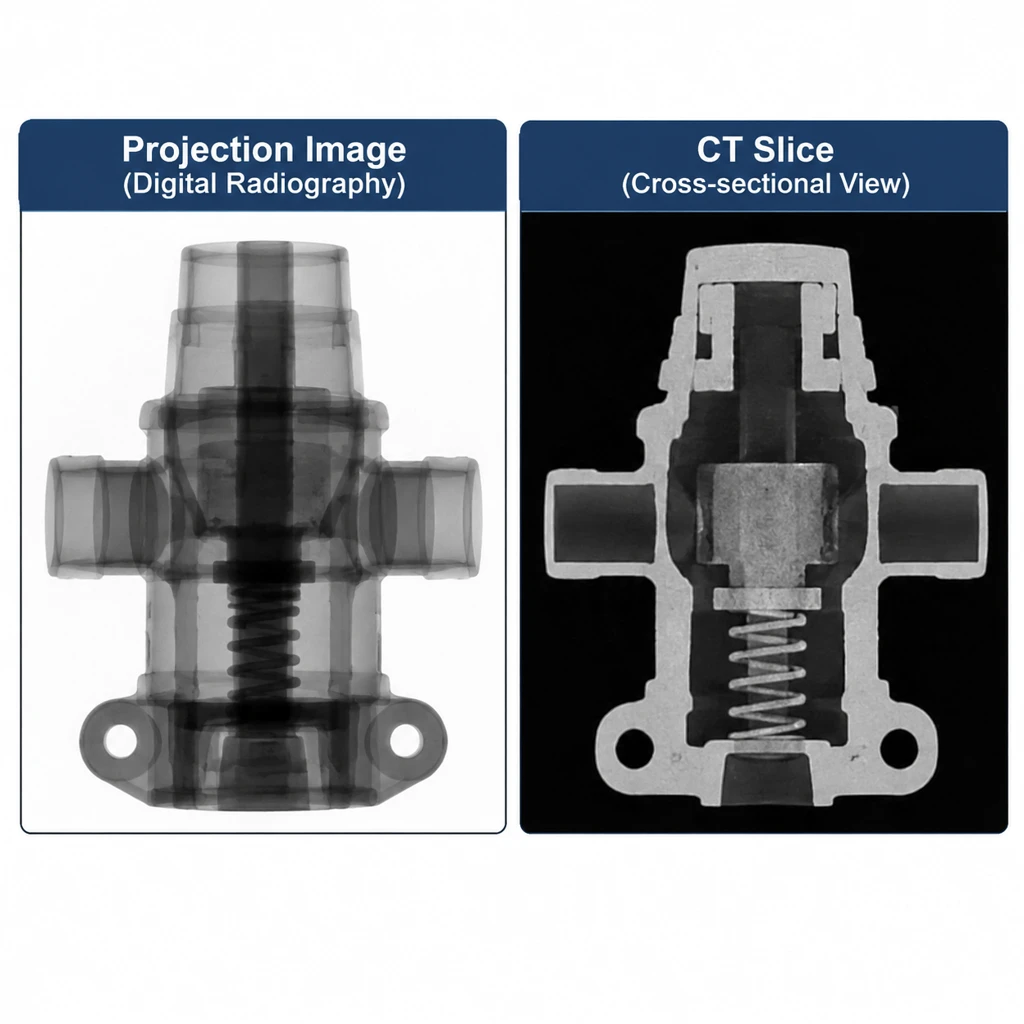
A confirmed industrial projection image paired with a CT slice of the same documented sample.