How Does X Ray Work? Why Thickness Changes the Image
How does x ray work when two regions of the same part look different? An industrial radiograph records differences in the radiation reaching a detector after passing through the sample. For the same material and incident spectrum, a thicker path generally attenuates more of the primary beam. That difference contributes to the image contrast.
Grayscale reflects more than material density
Material composition, density, path length, and photon energy all influence attenuation. A thick region of one material may produce a transmitted signal similar to a thinner region of another. Display settings can also change how the recorded signal appears. Grayscale alone therefore cannot establish material identity or prove that a region contains a defect.
The same principle explains why a normal cavity, a thickness transition, and an unintended void can create image features that need context. Interpret the radiograph alongside the expected part geometry and the direction of the beam. Brightness polarity may be reversed in software, so neither a bright area nor a dark area has a universal defect meaning.
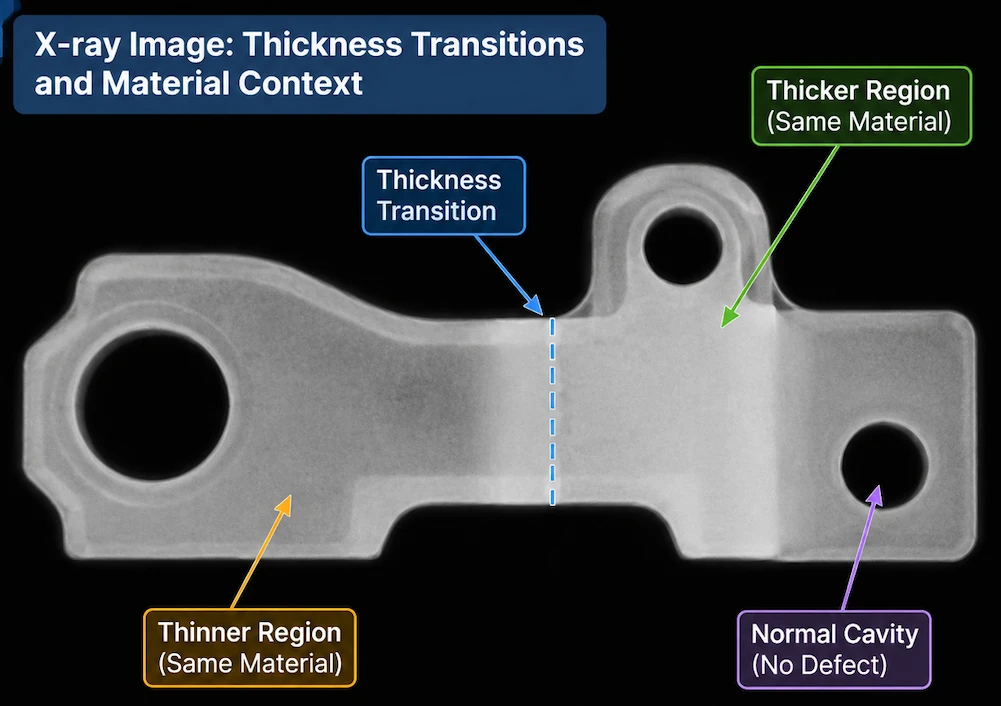
X-ray image of a sample with confirmed thickness transitions and known material composition.
Choose exposure for the feature that matters
An exposure must provide enough transmitted signal through the relevant region while retaining useful contrast. Simply increasing tube voltage does not guarantee a more informative image. Shenzhen Wahfei Technology Co.,Ltd. manufactures industrial X-ray inspection equipment. A representative sample and a clear description of the internal feature help connect exposure choices to the inspection task. The useful question is whether that feature can be distinguished reliably from normal structure under the selected conditions.