



How to choose a reliable industrial X-Ray system that meets inspection requirements in 2026?
- Pubdate 2026-03-20
How to Select Industrial X-Ray Equipment That Meets Your Product Inspection Requirements
The core value of industrial X-ray inspection lies in its non-contact, non-destructive method of penetrating object surfaces to reveal internal structures and defects, providing objective and reliable quality data for manufacturing processes. However, with a wide variety of equipment available on the market—such as open-tube micro-focus, closed-tube industrial CT, SMT inline X-Ray, and high-speed 3D AXI—if you do not systematically clarify your own requirements before procurement, it is easy to fall into the dilemma of "insufficient precision leading to missed detections" or "overkill causing waste". Wahfei Technology will systematically analyze the key selection points of various X-Ray equipment from the dual dimensions of technical logic and application scenarios, helping you make the most practical investment decision.
I. Four Core Dimensions That Must Be Clarified Before Selection
Before comparing specific equipment, it is recommended to first evaluate your needs from the following four dimensions. These will directly determine the equipment's technical type, core parameters, and reasonable budget range:
| Selection Dimension | Core Evaluation Questions | Direct Impact on Equipment Selection |
|---|---|---|
| Inspection Precision | What is the smallest defect size that needs to be identified? Does it involve sub-micron or near-nano level features? | Determines whether an open-tube micro-focus X-ray source is required (capable of achieving<1μm focal spot size) |
| Inspection Dimension | Is a 2D planar projection image sufficient? Or is 3D tomographic reconstruction data necessary? | Determines whether industrial CT or 3D AXI solution is needed, rather than ordinary 2D inline X-Ray |
| Production Mode | Is it real-time full inspection on the production line, or offline scenarios for R&D verification/batch sampling? | Determines the choice between inline (AXI / LX series) and offline (CT / S series) |
| Material Under Test | Is the tested object thin chip packaging, aluminum alloy castings, or lithium battery modules? | Determines the required tube voltage range, detector configuration, and whether HDR algorithm support is needed |
II. 160kV Transmission Open-Tube Micro-Focus X-Ray
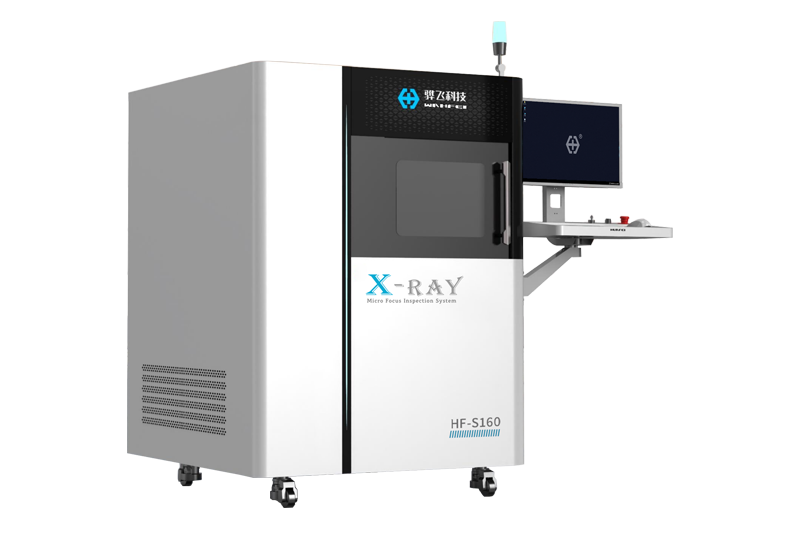
Technical Core: Breaking Through Closed-Tube Bottlenecks, Advancing Towards Near-Nano Level Resolution
As semiconductor components continue to evolve toward smaller process nodes, advanced packaging technologies (Flip Chip, CoWoS, 3D-IC stacking) have pushed X-Ray inspection precision requirements to the nano level. Traditional closed-tube X-ray sources are limited by their sealed structure and heat dissipation design; even when the focal spot is reduced to 3~5μm, significant penumbra effects still occur under high geometric magnification, resulting in blurred details and distorted edges that fail to accurately reproduce sub-micron solder joint defect contours.
Open-tube micro-focus X-ray source fundamentally breaks through the performance ceiling of closed-tube technology through its replaceable target and vacuum-sealed chamber design, achieving qualitative leaps in four key indicators:
| Smaller Focal Spot Size | Capable of achieving sub-micron or even near-nano level focal spots, meeting<1μm high-precision inspection needs and completely eliminating penumbra blur |
| Higher Tube Voltage | Up to 160kV, significantly superior penetration capability compared to similar closed-tube products, suitable for thicker material inspection needs |
| Larger Cone Angle and Magnification | Larger X-ray cone angle supports extremely high geometric optical magnification, delivering extremely high local microscopic detail resolution |
| Replaceable Target | Extends overall equipment service life and effectively reduces total cost of ownership (TCO) over the full lifecycle |
Main Applicable Scenarios
Semiconductor Advanced Packaging: Void, bridging, and cold solder joint detection in BGA, Flip Chip, PoP, and 3D stacked packages; identifying μm-level failure mechanisms;
Wearables & High-End Consumer Electronics: Internal structural integrity inspection of high-density packaged products such as TWS earphones, smart watches, and AR/VR modules;
Automotive Electronics & ADAS: Internal solder joint quality verification for automotive-grade sensors, controllers, and other components with stringent reliability requirements;
Aerospace & Military Main Control Boards: Core boards requiring compliance with high-reliability standards such as MIL-STD; zero-miss-detection requirements drive demand for the highest-precision sources.
Selection Recommendation: If your products involve advanced semiconductor packaging or high-reliability certification scenarios, and existing closed-tube equipment has encountered resolution bottlenecks or missed-judgment issues, it is recommended to prioritize evaluation of open-tube micro-focus solutions. In the context of vigorous promotion of domestic substitution, Wahfei open-tube X-Ray systems can effectively prevent being held back by foreign technology and achieve independent control of high-precision inspection capabilities.
III. Closed-Tube Micro-Focus Industrial CT (HF-S180) — Efficient 3D Inspection Platform for New Energy, Castings, and Electronics Manufacturing
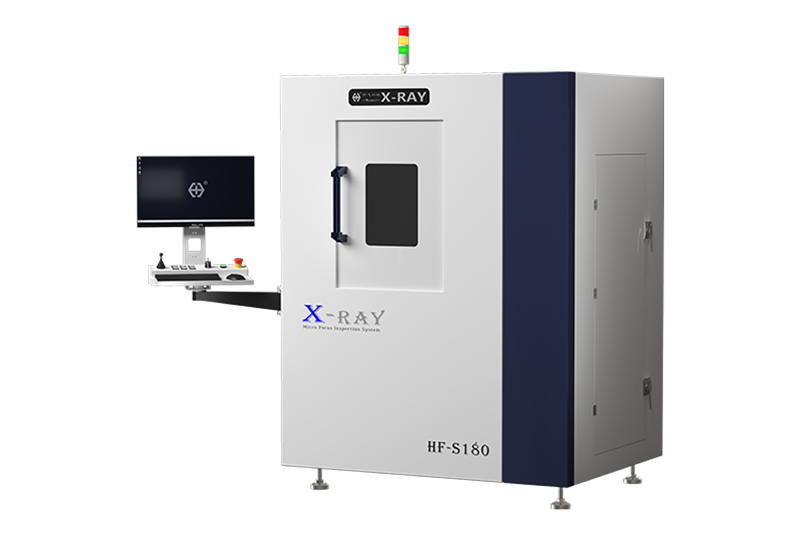
High-Speed 3D Reconstruction × AI Automatic Defect Recognition — Comprehensive Revelation of Internal Structures, Significantly Reducing Manual Interpretation Costs
Closed-tube micro-focus X-ray sources offer significant advantages in stability and procurement cost. When combined with 3D CT reconstruction technology and AI defect recognition algorithms, their overall inspection capability is sufficient to cover the vast majority of industrial quality inspection scenarios. The Wahfei HF-S180 Industrial CT Machine, as the flagship high-speed automatic model, has mature deployment cases in the three major tracks of castings/weldments, new energy batteries, and electronics manufacturing, and delivers the following core capabilities:
160kV High Penetration: Compatible with aluminum alloy castings, lithium battery modules, IGBT power devices, and other materials; a single machine covers multi-category inspection needs;
High-Speed 3D Reconstruction: Stereoscopic visualization of internal 3D structures, supporting tomographic analysis in any cross-section direction and truly reproducing the spatial morphology of defects;
HDR Algorithm Enhancement: Adaptive dynamic range compression that preserves global information while enhancing local details, solving imaging balance challenges in metal-polymer composite structures;
AI Automatic Defect Detection: Deep-learning-based semantic segmentation algorithm that automatically annotates suspected defect areas and provides confidence scores, significantly improving inspection accuracy and efficiency while greatly reducing missed and false judgments;
Automatic Point Scanning: After pre-editing inspection points, automatic continuous execution is supported, with barcode recognition and product binding; compatible with both fully automatic and manual review modes.
Main Applicable Scenarios
New Energy Battery Inspection: 3D quantitative analysis of lithium battery tab welding quality, cell internal winding alignment, and potential internal short-circuit risks;
Integrated Circuits & Electronic Components: Efficient batch screening of defects such as void rate calculation and pin connection integrity inside capacitors and IC packages;
Casting & Weld Seam Inspection: 3D quantitative analysis of internal metallurgical defects such as porosity, cracks, and shrinkage cavities, supporting automatic defect grading and precise big-data statistics while greatly reducing manual labor intensity.
Selection Recommendation: If your inspection scenarios require 3D tomographic analysis, while also accommodating efficient batch inspection of multiple product categories and having high expectations for equipment automation and AI intelligence levels, the HF-S180 is the preferred solution for quality inspection production line upgrades. It is especially suitable for the casting industry transitioning from "manual image interpretation" to "intelligent digital quality inspection".
IV. Industrial 3D CT Inspection Machine (HF-XT1000) — Full 3D Restoration for Precision Small Devices
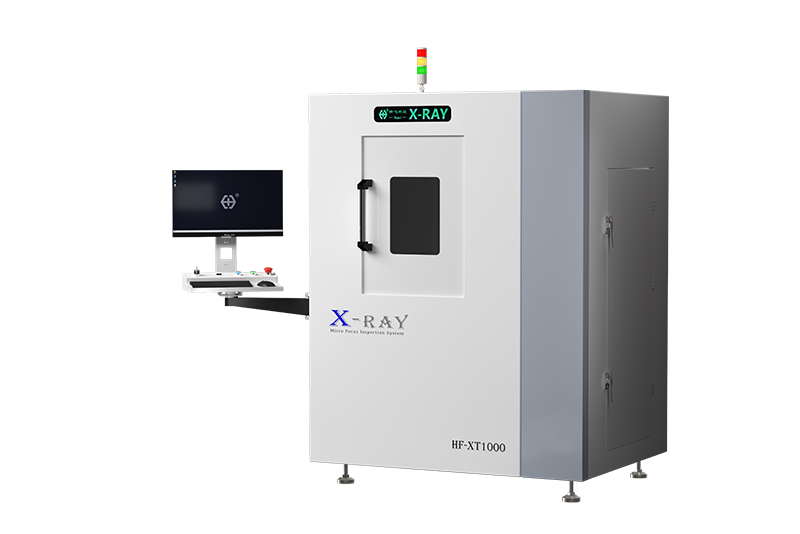
Real-Time Scan Reconstruction × Intelligent Defect Color Rendering — Making Hidden Defects Visible
When the tested object has a complex structure and defects exhibit three-dimensional spatial distribution, 2D X-Ray planar images often mask the true location and morphology of defects due to multi-layer projection overlap, causing serious missed judgments. The Wahfei HF-XT1000 3D CT Inspection Machine adopts advanced real-time scanning synchronous reconstruction technology, completing 3D data calculation during the scanning process and greatly shortening the single-piece inspection cycle. It is an efficient solution for R&D verification, incoming material sampling, and process optimization.
The HF-XT1000 is equipped with intelligent defect color rendering, intuitively marking defect locations, types, and severity with differentiated colors to assist quality engineers in completing precise judgments within seconds. Combined with HDR enhancement algorithms, even composite structures with coexisting high-density metal and low-density polymer can yield 3D images with complete details and balanced contrast.
Main Applicable Scenarios
3D internal structural integrity analysis and defect localization for electronic components, capacitors, and IC chips;
Internal connection structure verification for lithium battery cells and modules;
Non-destructive testing and process verification for 5G communication substrates, precision sensors, and aerospace components;
High-value-added scenarios such as teaching/research, sample analysis, and first-article inspection (FAI) for new products.
Selection Recommendation: Suitable for R&D and quality inspection scenarios requiring full 3D analysis of precision small devices, especially when the tested object size is within 100mm and there are clear requirements for three-dimensional spatial defect localization accuracy. The HF-XT1000 offers excellent cost-effectiveness.
V. SMT Inline X-Ray Inspection Machine (HF-LX1500) — 2D Real-Time Full Inspection Solution for High-Volume Production Lines
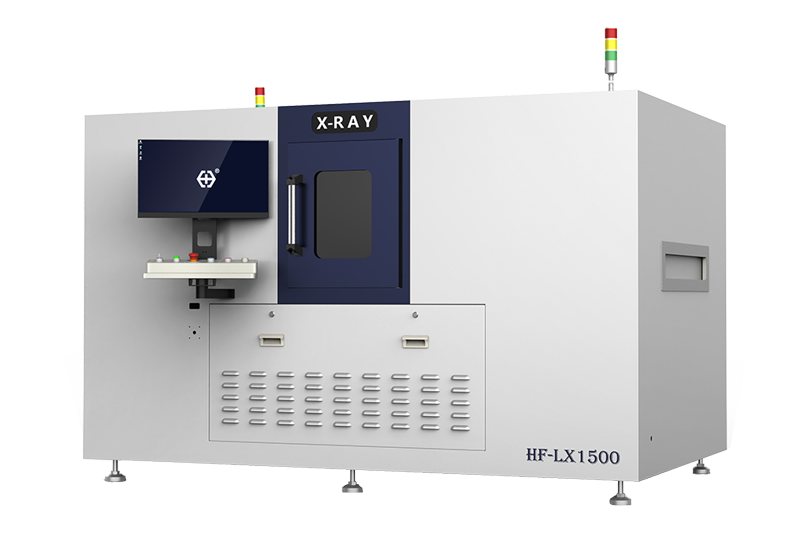
Seamless Integration into SMT Production Lines — MES Linkage, Automatic Sorting, Closed-Loop Quality Control
For continuous high-volume SMT production lines, reliance on manual offline sampling carries obvious timeliness lag risks—by the time defects are discovered, the line has often already produced a large quantity of defective products. The HF-LX1500 SMT Inline X-Ray Inspection Machine can be directly embedded into the production line body, enabling 2D real-time imaging and automatic judgment during material flow, and building a closed-loop quality feedback system from inspection to sorting:
MES Data Real-Time Upload: Inspection results and process data are synchronously uploaded to the production management system, supporting traceability analysis and SPC statistical process control;
NG/OK Automatic Sorting Identification: Automatic marking and interception of defective products, eliminating manual missed-screening risks and ensuring outgoing product quality;
Code Reader Automatic Recognition: After scanning product codes, the inspection program is automatically associated to achieve one-board-one-record precise quality documentation;
Flexible Voltage Configuration: Standard 90kV, optional upgrade to 110kV or 130kV, comfortably handling inspection needs for different material thicknesses and solder joint densities;
Large-Size Flat Panel Detector: 1800mm×650mm (customizable), 5~15μm resolution, compatible with full-frame inspection of mainstream PCB specifications.
Selection Recommendation: Suitable for SMT manufacturing enterprises with high output and primary needs for 2D planar solder joint inspection, as well as smart factory scenarios requiring deep integration with ERP/MES. If the tested products involve multi-layer stacked boards or BGA pad image overlap causing interpretation difficulties, upgrading to a 3D AXI solution is recommended to achieve higher inspection confidence.
VI. High-Speed Inline 3D AXI Planar CT
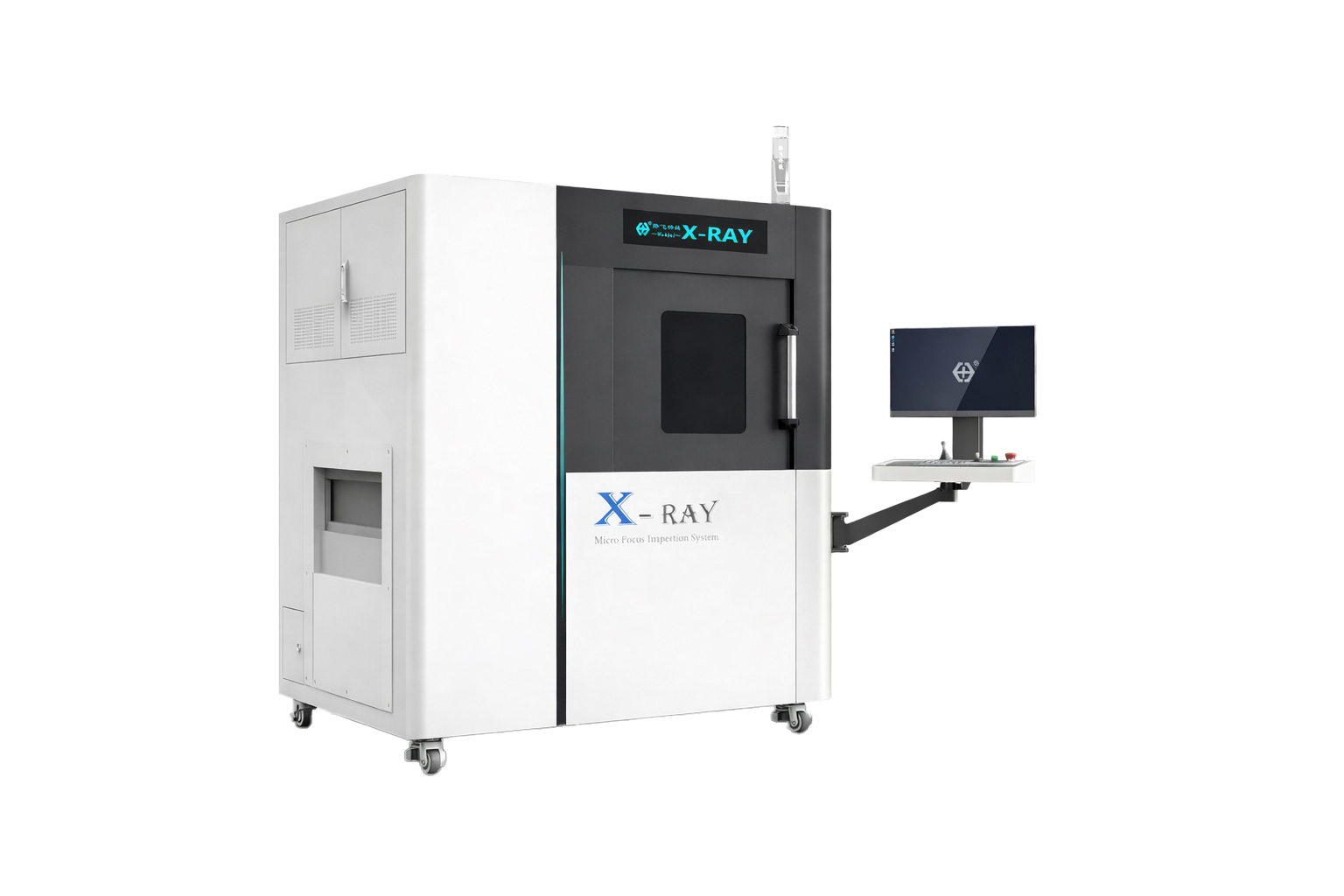
360° Circular Multi-Angle Acquisition × Scan-While-Reconstruct — Inline Inspection Speed with CT Tomographic Precision
Traditional 2D AXI can only acquire planar projection images from a single oblique angle. When facing hidden solder joints such as BGA and PoP, image overlap from upper and lower layers causes a large number of false and missed judgments, severely affecting inspection credibility. With the continuous improvement of automation manufacturing process requirements in the integrated circuit and new energy industries, market demand for high-speed inline 3D inspection equipment has become increasingly urgent.
The Wahfei Inline 3D AXI Planar CT acquires multi-angle projection data through 360° circular motion, completing 3D CT reconstruction while scanning and generating real-time tomographic slice images of any XY layer. It completely separates solder joint information at different levels, greatly improving inspection efficiency and reliability, and significantly surpassing the capability boundaries of existing inline equipment in both inspection speed and functionality.
Typical defect types that can be precisely identified include:
BGA / LGA solder joint void rate quantitative statistics and automatic IPC standard comparison;
Inter-layer separation and failure localization in Flip Chip and PoP multi-layer stacked packages;
Full-type defects such as voids, bridging, cold solder joints, and head-in-pillow effects in QFN and IGBT device welding;
PTH through-hole solder fill rate quantitative verification;
Pressfit connector crimp depth and contact quality evaluation.
Selection Recommendation: If the production line involves 100% full inspection requirements for advanced packaged devices such as BGA, PoP, and IGBT, or if the false-positive and missed-detection rates of existing 2D AXI have substantively impacted line capacity and quality reputation, the Wahfei 3D AXI solution provides a reliable domestic substitution choice for high-demand electronic terminal manufacturers with higher inspection confidence and lower overall false-judgment rates.
Tell Us Your Inspection Needs — Wahfei Provides Precise Recommendations for You
X-Ray equipment selection is a systematic engineering task that requires comprehensive consideration of the tested object's material and size, minimum detectable defect size, inspection dimension (2D/3D), production line takt time and automation requirements, as well as long-term equipment maintenance costs. Wahfei Technology has been deeply engaged in the industrial X-Ray intelligent inspection field for many years, accumulating extensive industry cases and inspection data across multiple segments including integrated circuits, new energy batteries, castings and weldments, automotive electronics, and aerospace/military applications. It has formed a complete solution system from equipment hardware to the Wahfei X-Mind software algorithm platform.
Before you finally confirm procurement, please be sure to clearly inform the Wahfei team of the following key information: product types and materials to be inspected, core defect characteristics and minimum acceptable inspection size, annual output and takt time requirements, and whether MES system integration is needed. Our application engineers will provide one-on-one professional selection evaluation based on this, and can arrange sample pre-inspection validation to ensure the equipment truly meets your process requirements and that every investment dollar is fully utilized.